As you know from earlier posts, I have the perfect pie crust recipe. Never-fail, turns out exactly the same every time. So how could I end up with anything less than perfect pie?
I blame the low-sugar, no-white flour, mostly vegan culinary journey I'm taking this summer, trying to get my body in the best shape I can for some upcoming distance running challenges (some of the greatest American distance athletes, such as ultramarathoner Scott Jurek and pro cycling stud David Zabriskie are vegan. Ergo my foray into falafel burgers). I haven't thought about white flour for quite a while, but it didn't occur to me that I wouldn't have any in stock when the 4th of July came around--a day that always calls for apple pie. I've got my butter and crisco chilling, water and vodka all icy, and no white flour. But I do have whole grain pastry flour--it being pastry flour should make up for not being refined, right?
Wrong. I ended up with a soggy, squishy mass of dough that would barely shape into crust. In the end it tasted quite good, but what a difficult mess! The fact that it was quite healthy (aside from all that lovely butter and crisco) was my only consolation. Moral of this story: when you're baking, don't mess around with ingredients. Head out the door, get that white flour, and do it right.
To make up for my uncertainty with the pie crust, I put extra effort into the filling. That's what's lovely about pie filling--it's more like cooking (which I love) than baking (which always challenges me) in that ingredients are flexible and can always be messed with.
I did take care with the size and shape of the apple pieces for optimal texture. Since I still didn't have white flour, I used soy flour as my thickener instead, and it worked beautifully--I think I'll stick with it for this purpose. To complement the whole grain crust, I increased the proportion of brown sugar, using very little white. I tossed in a few splashes of vanilla extract, and orange juice instead of lemon, relying on a little rice vinegar to provide an acidic kick. Zesting the orange peel pumped up the citrus aspects, and then to top it all off, along with the usual cinnamon, dash of salt and splashes of tabasco, on impulse I threw in fresh-cracked black pepper. Even though sampling the filling mixture didn't give me a clear idea of the final outcome, I trusted that baking would develop and draw these ingredients into harmony--which is exactly what happened. It was apple pie, yes, but apple on steroids. You might wonder what new or ancient variety, what heirloom apples from what special farmers' market nestled between those ugly (but tasty) brown crusts? Certainly not those one-note standbys, Granny Smiths. That's the magic of orange zest and rice vinegar and vanilla and especially (I believe) cracked black pepper.
From now on, not only will I always mince jalapeno into my strawberry jam, but never forget to include the cracked black pepper in my apple pie.
Thursday, July 5, 2012

Tuesday, June 19, 2012
Falafel Burgers
On a recent stay in Santa Barbara, I discovered the joy of falafel burgers at a place called The Habit. With a basket of sweet potato fries on the side, I was in heaven. It was one of those meals that you savor as you eat, and then again in memory.
My brother Doug teaches cooking and healthy lifestyle classes with his wife Patricia. He's always looking for a better veggie burger recipe, and when I heard an NPR interview with a chef who'd devoted a whole cookbook to the topic, I immediately thought of Doug, hopped on Amazon, and ordered a copy for his birthday. I got myself a copy as well, but let it sit on the shelf until that happy meal at The Habit. Suddenly, I was all about digging into Lukas Volger's Veggie Burgers Every Which Way.
Sure enough, there was a falafel burger recipe. I've made it twice already in the past week, even though there are so many other enticing burgers that I ought to branch out. However, it's fun to really learn a recipe, go to school on it. The burgers were tasty the first time, but I wanted to improve my results. There are things I like better about my second try, but others that I preferred about my first. I'm definitely giving this recipe a few more rounds along with sampling other burgers from the book. It's not like the recipes are so complicated, but having my best version of something makes me happy.
What made the second try a little more complicated was my inattention at the start--I soaked double the amount of chickpeas, then decided to simply double the whole recipe rather than waste the rehydrated peas. My food processor isn't big enough to handle so much volume, and working in stages got in the way of attaining an ideal texture. However, the ingredients were better. This time, I had cumin seeds--last time I'd settled for ground cumin. The recipe calls for thickening (only if necessary) with a little chickpea flour; so far I haven't located any. The first go round I used whole wheat, this time it was soy flour, just to be different. Next I'll try it without the flour--the mixture seems so loose and wet when forming the patties, but baking dries it out quite a bit, and it should still hold together, not crumble, even without the help of an extra binding agent.
 I also tossed in a fat handful each of chia and flax seeds in honor of ultramarathoner (and vegan foodie) Scott Jurek, whose Eat & Run not only offers great nutrition advice but concludes each chapter with an enticing recipe.
Next time I'll be patient and grind the flax seeds first--their crunch was a little too assertive, and the body can't absorb as many nutrients from whole seeds. They aren't all all necessary to the recipe, but it's always good to find ways to incorporate flax into one's diet, particularly for runners (and women--especially peri- or post-menopausal).
Today I stacked the burger with some tzatziki-inspired cucumbers, fresh tomatoes, and lightly wilted purple kale. I thinly sliced the cucumbers and onions, sprinkled them with salt, pepper, dried mint, and lemon juice, and mashed them into plain Greek yogurt.
Even though handling so much falafel mixture was a pain, I'm not sorry to have 11 more burgers stashed in the freezer. My experience with the first batch is that the flavor develops even more over the next 24 hours, and the patties heat up beautifully in the microwave without affecting texture.
Lukas Volger shares many of his recipes on his website: www.lukasvolger.com, although this one isn't there. It's best to just buy his wonderful cookbook, but if you want to try the burger, another blogger did post the recipe, along with her tips: www.madriverkitchen.com/2011/04/baked-falafel-burger-with-tzatziki.html
I'll add to the post as I work on the recipe, but it's all about tweaking my rendition of it, not the recipe itself, which is simply wonderful and easy to produce (so long as you don't double the chickpeas and decide to go ahead and run with it).
My brother Doug teaches cooking and healthy lifestyle classes with his wife Patricia. He's always looking for a better veggie burger recipe, and when I heard an NPR interview with a chef who'd devoted a whole cookbook to the topic, I immediately thought of Doug, hopped on Amazon, and ordered a copy for his birthday. I got myself a copy as well, but let it sit on the shelf until that happy meal at The Habit. Suddenly, I was all about digging into Lukas Volger's Veggie Burgers Every Which Way.
Sure enough, there was a falafel burger recipe. I've made it twice already
 in the past week, even though there are so many other enticing burgers that I ought to branch out. However, it's fun to really learn a recipe, go to school on it. The burgers were tasty the first time, but I wanted to improve my results. There are things I like better about my second try, but others that I preferred about my first. I'm definitely giving this recipe a few more rounds along with sampling other burgers from the book. It's not like the recipes are so complicated, but having my best version of something makes me happy.
What made the second try a little more complicated was my inattention at the start--I soaked double the amount of chickpeas, then decided to simply double the whole recipe rather than waste the rehydrated peas. My food processor isn't big enough to handle so much volume, and working in stages got in the way of attaining an ideal texture. However, the ingredients were better. This time, I had cumin seeds--last time I'd settled for ground cumin. The recipe calls for thickening (only if necessary) with a little chickpea flour; so far I haven't located any. The first go round I used whole wheat, this time it was soy flour, just to be different. Next I'll try it without the flour--the mixture seems so loose and wet when forming the patties, but baking dries it out quite a bit, and it should still hold together, not crumble, even without the help of an extra binding agent.
 I also tossed in a fat handful each of chia and flax seeds in honor of ultramarathoner (and vegan foodie) Scott Jurek, whose Eat & Run not only offers great nutrition advice but concludes each chapter with an enticing recipe.
 Next time I'll be patient and grind the flax seeds first--their crunch was a little too assertive, and the body can't absorb as many nutrients from whole seeds. They aren't all all necessary to the recipe, but it's always good to find ways to incorporate flax into one's diet, particularly for runners (and women--especially peri- or post-menopausal).
Today I stacked the burger with some tzatziki-inspired cucumbers, fresh tomatoes, and lightly wilted purple kale.
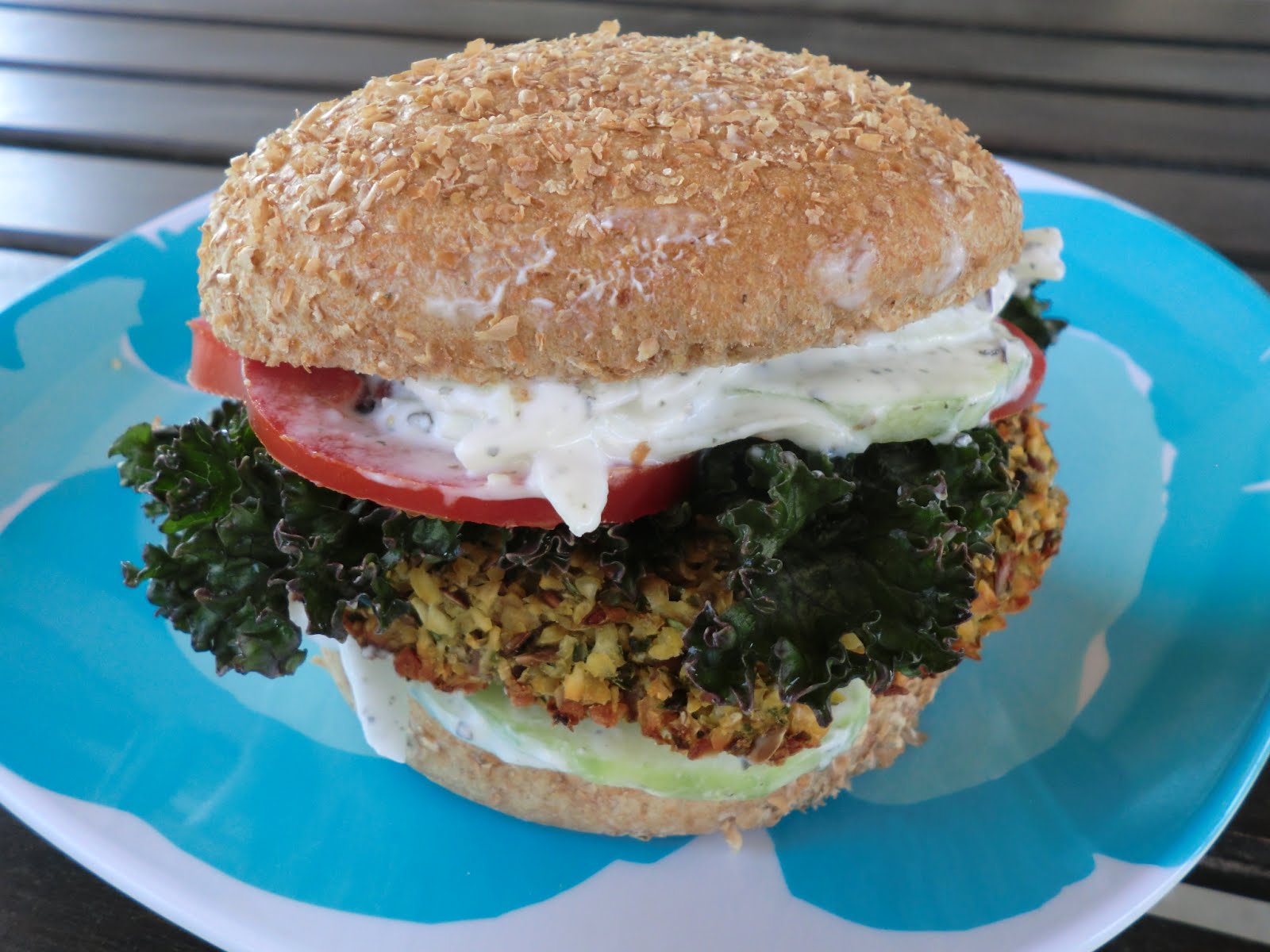 I thinly sliced the cucumbers and onions, sprinkled them with salt, pepper, dried mint, and lemon juice, and mashed them into plain Greek yogurt.
 Even though handling so much falafel mixture was a pain, I'm not sorry to have 11 more burgers stashed in the freezer. My experience with the first batch is that the flavor develops even more over the next 24 hours, and the patties heat up beautifully in the microwave without affecting texture.
Lukas Volger shares many of his recipes on his website: www.lukasvolger.com, although this one isn't there. It's best to just buy his wonderful cookbook, but if you want to try the burger, another blogger did post the recipe, along with her tips: www.madriverkitchen.com/2011/04/baked-falafel-burger-with-tzatziki.html
I'll add to the post as I work on the recipe, but it's all about tweaking my rendition of it, not the recipe itself, which is simply wonderful and easy to produce (so long as you don't double the chickpeas and decide to go ahead and run with it).
Sunday, June 10, 2012
Too much of a good thing can be great
Buckwheat and Blueberries and Bananas and Walnuts Oh My! It's a rare event, but for some reason or other I missed breakfast. Lunch hit the spot but by the evening I was a hungry hungry gal. And I still hadn't had breakfast, my favorite meal of the day.
Time for pancakes. I love oatmeal pancakes, but when I'm this hungry, it's all about the buckwheat. Bob's Red Mill mix. They don't make the prettiest cakes--not like the beautiful fluffy circles you see at Denny's or IHOP. Also, by the time I'm done adding all my extras, they're downright lumpy and misshapen--and yummy and healthy and oh, so satisfying. No bacon or sausage on the side necessary.
Most people keep their buckwheat pancakes simple, no add-ins, just a little butter and syrup on top. When you consider how much buckwheat offers all on its own, this is understandable. Buckwheat isn't wheat (it's actually related to rhubard and is gluten-free). It has fewer calories than wheat but more protein and fiber, and is chock full of vitamins and minerals. For most, its rich flavor calls for a straightforward treatment. That way, there's still room on the palate for the traditional sides--a couple of strips of bacon, a little fresh fruit.
I can't leave well enough alone. Any pancake is better with blueberries, or banana, or chopped nuts. And when it's just me eating, I throw it all in. Too much? (nah!) of a good thing is just right.
I always have a stash of these ingredients in the freezer. When fresh bananas are perfect for eating, they're too firm and not sweet enough for cooking. If one manages to stay in the fruit bowl long enough to pass the point of ripeness, I pop it in the freezer; thawed, it becomes fragrant banana puree with barely the touch of a fork. With the buckwheat batter, I probably should stick to half a banana, especially when it's not the only extra. My pancakes would spread out more uniformly on the griddle. But there sits the rest of that banana, begging to be included, and anyway the theme of this recipe is Too Much, so why not?
Because of their fat content, walnuts seem to keep better in the freezer. I love them in everything (cf. my fridgeluck pasta entry from last September) so I make sure never to run low. A generous handful goes in with the banana puree. I don't add the blueberries until right before cooking, otherwise they freeze to one another and pile up when spooned on the griddle. I add them right out of the freezer--if they thaw at all they water down the batter. Some people sprinkle the blueberries onto the batter after it's on the griddle--you get prettier, more uniform shapes, but the berries can burn when the pancakes are flipped since they have no batter to insulate them from the hot surface.
Even though these pancakes, made with extra-flavorful buckwheat flour and crammed with too many add-ins, are already oh-so-flavorful, I'm not done. Maybe it's the German in me, but rather than maple syrup and butter, I've always preferred sour cream and jam on my pancakes. Kind of blintz-ish. It's been a long time since I've kept sour cream in the fridge, however, because what I love even more these days is Fage Greek yogurt. Even the nonfat version is naturally thick and creamy. The flavor is smooth and just the right amount of sour. Add a touch of honey, and it's just the right amount of--well, not sweet, but fragrant and fresh.

Another nice thing about all that yogurt is that it transforms bumpy lumpy pancakes into something a little more artistically appealing. Spoon a little apricot jam on top, and you have yourself quite a Continental supper.
The leftover pancakes keep very well in the fridge, separated by a little wax paper. Pop one or two in the toaster and you have a breakfast that will keep you all morning, or power you through a hilly 10K.
Buckwheat Blueberry Banana Walnut Pancakes--ugly, yummy, low-fat, high fiber, high protein, super-nutritious, super-easy, and downright decadent--too much of a good thing is exactly the right amount of everything.
Time for pancakes. I love oatmeal pancakes, but when I'm this hungry, it's all about the buckwheat. Bob's Red Mill mix. They don't make the prettiest cakes--not like the beautiful fluffy circles you see at Denny's or IHOP. Also, by the time I'm done adding all my extras, they're downright lumpy and misshapen--and yummy and healthy and oh, so satisfying. No bacon or sausage on the side necessary.
Most people keep their buckwheat pancakes simple, no add-ins, just a little butter and syrup on top. When you consider how much buckwheat offers all on its own, this is understandable. Buckwheat isn't wheat (it's actually related to rhubard and is gluten-free). It has fewer calories than wheat but more protein and fiber, and is chock full of vitamins and minerals. For most, its rich flavor calls for a straightforward treatment. That way, there's still room on the palate for the traditional sides--a couple of strips of bacon, a little fresh fruit.
I can't leave well enough alone. Any pancake is better with blueberries, or banana, or chopped nuts. And when it's just me eating, I throw it all in. Too much? (nah!) of a good thing is just right.
I always have a stash of these ingredients in the freezer. When fresh bananas are perfect for eating, they're too firm and not sweet enough for cooking. If one manages to stay in the fruit bowl long enough to pass the point of ripeness, I pop it in the freezer; thawed, it becomes fragrant banana puree with barely the touch of a fork. With the buckwheat batter, I probably should stick to half a banana, especially when it's not the only extra. My pancakes would spread out more uniformly on the griddle. But there sits the rest of that banana, begging to be included, and anyway the theme of this recipe is Too Much, so why not?
Because of their fat content, walnuts seem to keep better in the freezer. I love them in everything (cf. my fridgeluck pasta entry from last September) so I make sure never to run low.
 A generous handful goes in with the banana puree. I don't add the blueberries until right before cooking, otherwise they freeze to one another and pile up when spooned on the griddle. I add them right out of the freezer--if they thaw at all they water down the batter. Some people sprinkle the blueberries onto the batter after it's on the griddle--you get prettier, more uniform shapes, but the berries can burn when the pancakes are flipped since they have no batter to insulate them from the hot surface.
Even though these pancakes, made with extra-flavorful buckwheat flour and crammed with too many add-ins, are already oh-so-flavorful, I'm not done. Maybe it's the German in me, but rather than maple syrup and butter, I've always preferred sour cream and jam on my pancakes. Kind of blintz-ish. It's been a long time since I've kept sour cream in the fridge, however, because what I love even more these days is Fage Greek yogurt. Even the nonfat version is naturally thick and creamy. The flavor is smooth and just the right amount of sour. Add a touch of honey, and it's just the right amount of--well, not sweet, but fragrant and fresh.

Another nice thing about all that yogurt is that it transforms bumpy lumpy pancakes into something a little more artistically appealing. Spoon a little apricot jam on top, and you have yourself quite a Continental supper.
The leftover pancakes keep very well in the fridge, separated by a little wax paper. Pop one or two in the toaster and you have a breakfast that will keep you all morning, or power you through a hilly 10K.
Buckwheat Blueberry Banana Walnut Pancakes--ugly, yummy, low-fat, high fiber, high protein, super-nutritious, super-easy, and downright decadent--too much of a good thing is exactly the right amount of everything.
Wednesday, March 28, 2012
Eat real food

I understand the allure of meaty, hearty meals. It's just that you don't need a butcher to get you there. That's why god gave us beans and herbs and all sorts of other lovely ingredients. The other day my friend Maryanne reminded me of Michael Pollan's most basic rule: Eat real food. Mostly plants.
We were at our favorite produce stand, browsing among the lettuces. I had a crockpot of cranberry beans simmering at home (they are very similar to pintos, just a little larger and sweeter, and cook a bit faster) and, as I surveyed all the options for turning them into a delicious meal, I wondered why anyone would be offended by Pollan's love of actual, authentic food. You'd be amazed at the names he gets called: Food Nazi is one of the kinder ones.
I came home with not only the Fairytale Pumpkin whose story has yet to turn magical (see earlier post), but also a box of good ol' fashioned local produce that is finding its way into my delicious

Kitchen Herbs
I don't even have time for a PG-rated garden of my own right now. Fortunately, I live where it's easy to find lots of fresh produce at farmer's markets and stands. With real estate in a slump, investors are holding on to open land and farming is a good way to catch some extra tax breaks while doing so. I make strawberry jam from berries grown and sold a mile from here on a couple of acres tucked in between housing developments.
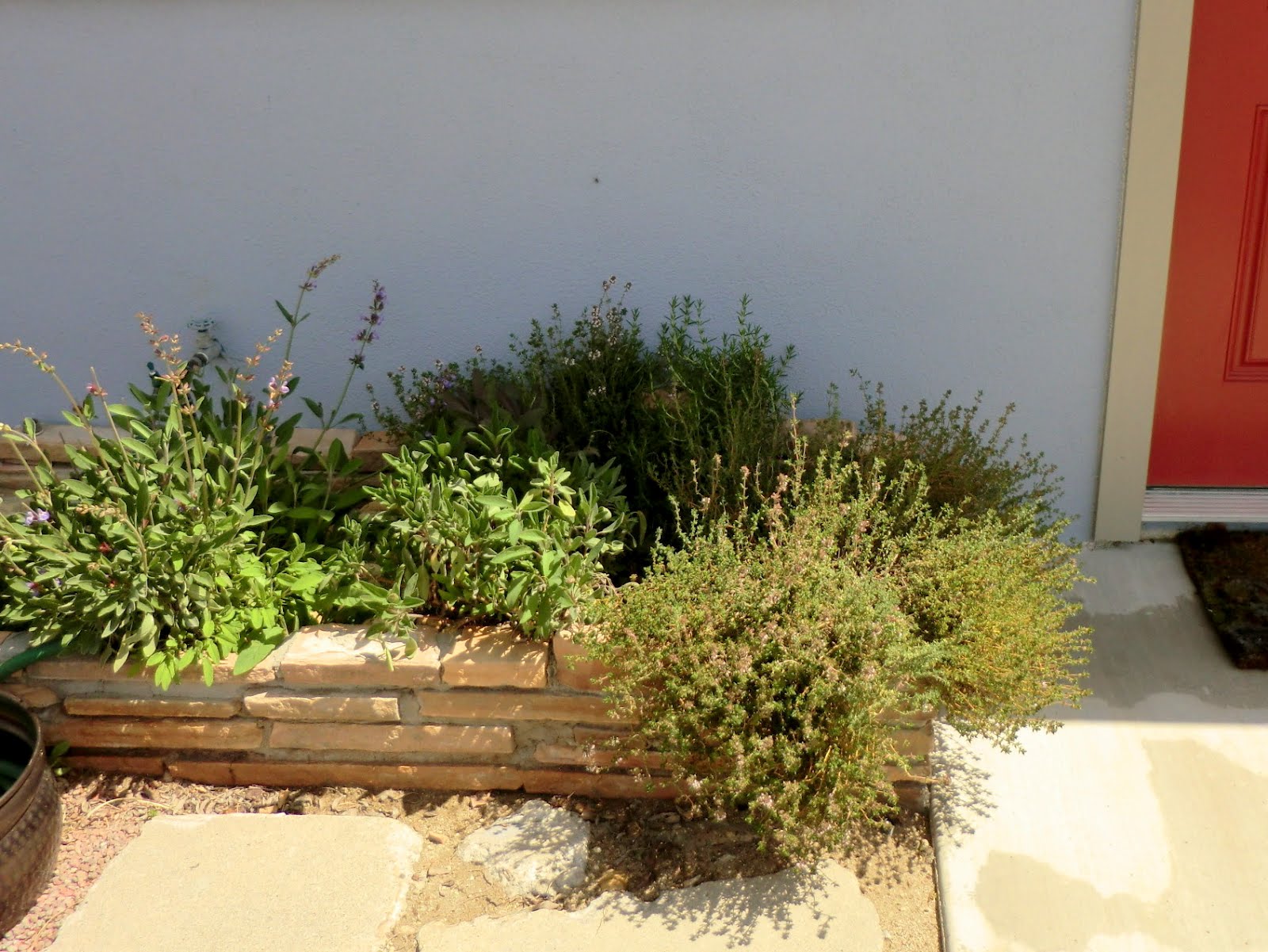
The one thing that truly needs to come "fresh off the vine" is fresh herbs. Because they don't keep well they're expensive at the market, so growing your own isn't just a culinary advantage, it makes economic sense as well. Fortunately, this takes no extra time or effort on your part. I've devoted a corner of a planter right next to my front door to rosemary and several varieties of thyme and sage, and oregano grows among the flagstones next to the stoop. These herbs need so little attention--non-culinary versions of them all show up throughout my low-water landscaping (and even those are edible, just a little sturdier). The hose is right next to the kitchen herbs so it's easy to spritz them regularly but if I get busy and miss even a week or two they hang right in there.
Most importantly, when I'm cooking all I have to do is pop out the door with a pair of scissors and snip all the freshness required to make a dish memorable.
Monday, March 26, 2012
What's Cooking?

I found this Fairytale Pumpkin squash at the vegetable stand today. You can see how it got its name, from that shape found in so many illustrations of Cinderella. I sliced it up and discovered a rich deep orange flesh inside--this photo just can't do the color justice.

Now the chunks are roasting at 375 in the oven. I really have no idea what I'm going to do with them so we'll just have to see! It's fun to try something out.

More later, as this plays out. Anyone with ideas, please post!
Next day: Well, so far no fairytale ending for the Fairytale Pumpkin. I followed roasting instructions I found on the internet and ended up with tough chunks of pumpkin. I should have known better. I will probably dice some of it up and throw into the stew I'm making this afternoon.
The name Fairytale Pumpkin is too alluring to give up on, so I'm picking up another one and will try again using a roasting pan covered with foil to retain moisture.
It's fun to write about cooking successes, but the fact is that a lot of cooking is try, try again.
A couple of days later: Well, it wasn't a loss after all. I was in a hurry the other day so made a quick lunch by heating up a big chunk of the cooked pumpkin, finishing off with a dab of butter and salt. The squash flavor had intensified by sitting in the fridge, and the flesh had rehydrated a bit. It was tasty and took me through the whole afternoon. I know something that deep orange and fiber-rich has to be super-healthy as well. I ate pumpkin for lunch again today. Even though it had been sitting in the fridge for 5 days, it was just as tasty. I can see this as an easy way to make lunches for school.
Tuesday, March 20, 2012
Sometimes it's worth it to think outside the box

I've made a lot of yummy cakes from mixes. Duncan Hines Lemon Supreme for example, finished with a can of Betty Crocker cream cheese frosting. Pretty damn good. And I've messed around with this cake recipe and that, because the write-up in the LA Times food section makes them sound so good. Last winter my friend Maryanne and I tag-teamed on a couple of sponge-cake recipes, trying to figure out which one worked best. But really, again, why do the work when someone else has done it for you? Someone like the great food scientist Shirley Corriher.
I've been hooked on Shirley since I first heard her interviewed on NPR's Fresh Air. My mom bought me her cookbook/textbook Cookwise, which teaches not only how to cook, but why. It's a fantastic tome. Then, my fried Gail started experimenting with her quickbread recipe, and said she sure wished she knew more about adjusting proportions as she changed her ingredients around. Well, bless Shirley's heart, she had just put out another cookbook all about that very topic: Bakewise. There was Gail's Christmas present (and of course one for me too).
Because she explains not only how to do something, but why, Shirley Corriher's recipes turn out yummy and reliable. She admits she has a powerful sweet tooth, and cakes are obviously nearest and dearest to her heart. There is no cake mix on earth that can come close to her Satin-Glazed Midnight Black Chocolate Cake. As much as I love chocolate, however, I have to award the blue ribbon to her Magnificent Moist Golden Cake. I baked it yesterday, and went to bed with the sweet perfume of vanilla and cream still hovering in the air.
Nonstick cooking spray with flour
4 Tbl unsalted butter, cut in 1-Tbl pieces
1 ½ cups sugar
2 tsp pure vanilla extract
1/3 cup canola oil
3 large egg yolks
2 large eggs
1 ¾ cups spooned and leveled cake flour (NO SUBSTITUTE!)
1 ¾ tsp baking powder
½ tsp salt
1/3 cup buttermilk
½ cup heavy cream
1. Arrange a shelf in the lower third of the oven, place a baking stone on it, and preheat the oven to 350.
2. Spray a 9 x 2-inch round cake pan with nonstick cooking spray with flour and line with a parchment circle, then lightly spray the top of the parchment, too.
3. In a mix on medium speed, beat the butter to soften. Beat until it is light in color, about 3 minutes. Add the sugar and continue to beat (cream) until very light, scraping down the sides and across the bottom of the bowl at least once. While creaming, feel the bowl; if it does not feel cool, place in the freezer for 5 minutes, then continue creaming.
4. Beat in the vanilla. On medium speed, blend in the oil.
5. On the lowest speed, blend in the yolks, one at a time, mixing just to blend. Blend in the whole eggs, one at a time, mixing just to blend.
6. In a medium mixing bowl, beat the flour, baking powder, and salt for a full 30 seconds at medium speed with a hand mixer or with a fork or whisk by hand.
7. On the lowest speed, blend over half of the flour mixture into the batter. Continue on lowest speed and blend in half of the buttermilk. Continue adding the remainder of the flour until all is incorporated. Blend in the remaining buttermilk.
8. In a cold bowl with cold beaters, whip the cream until soft peaks form when the beater is lifted. Beat just a little beyond this soft-peak stage. Stir about one-quarter of the whipped cream into the batter to lighten. Then fold the rest of the whipped cream into the batter.
9. Pour the batter into the prepared pan. Drop the pan onto the counter from a height of about 4 inches to knock out bubbles. Place the cake in the oven on the stone and bake until the center springs back when touched, or a toothpick inserted in the center comes out clean but moist, about 40 minutes. Ideally, the cake should not pull away from the sides until it has just come out of the oven. the center temperature should be about 209 degrees if you check by inserting an instant-read thermometer.
10. Place the cake in the pan on a rack to cool for about 10 minutes, then shake the pan to loosen the cake all around. spray a cooling rack with nonstick cooking spray and invert the cake onto the rack to finish cooling. Peel off the parchment. Cool completely before slicing into layers, storing, or icing.
Today, I sliced the cake into two layers and filled the middle with some homemade strawberry jam thinned with a little Grand Marnier and a nice helping of mocha frosting, made with Shirley's Basic Confectioners' Sugar Buttercream recipe. The outside is a thick layer of more of that frosting with walnuts pressed into the sides. Tom's about as Guy's Guy as a guy can get, so I didn't want to make it too frou-frou, but at the same time it's so much fun to play around with frosting tips, so I got a little flourish-y with the dark purple embellishments. I don't think he'll mind!
If you want the frosting recipe, or more details on the whys and wherefores of the cake recipe, or just want to spend some time learning really cool stuff about the science of baking, or just get your hands on a whole passel o' kick-ass recipes, you must check out Shirley's book (actually, check out both of them!); you can also catch her quite often on Alton Brown's Good Eats cooking show on the Food Network. Shirley teaches a lesson with each recipe in her book, and although I didn't take the time to include them here, she gives each amount in ounces and grams, which I often use to make sure I have the proportions perfect. They came in especially handy this time, since I used some of Gail's duck eggs to make the cake. They're larger than chicken eggs, and knowing exactly how much the yolks and whole eggs should weigh made it possible to use just the right amount. Bakers swear by duck eggs--the yolks are heavy and rich and assertive. All I know is that the cake turned out perfect.
Subscribe to:
Posts (Atom)