If you've been following my posts you know I've been having fun with my Veggie Burgers Every Which Way cookbook, along the way learning a lot about the foundation ingredients of non-soy veggie burgers. Tonight it was time to strike out on my own. What I like about these is that they make a really well-rounded meal--complete protein, lots of other nutrients, and just enough fat to be balanced and truly healthy, while still tasting indulgent. I used everything I've learned about boosting flavors with mushroom, walnuts, etc. to make a full-flavored burger. It's pretty simple and yummy yummy.
The result? Tastiest veggie burger I've ever made. For my gluten-free friends,this version is just your thang!
Without much further ado, here it is. Haven't had time to name it yet. Any suggestions?
Makes 8 patties
1/4 cup quinoa
1 15-oz can black beans (no-salt variety)
1 shallot
5 oz (1/2 bag) crimini mushrooms
2 carrots
Fat handful fresh greens, such as spinach, kale, etc. (I used Trader Joe's mixed baby power greens--spinach/chard/kale)
Fingerful of fresh mint (dried herbs would be fine)
1 tsp chopped fresh sage
1/2 tsp chopped fresh oregano
3 eggs, lightly beaten
2 Tbl brown mustard
1/3 cup grated parmesan cheese (unnecessary, but a nice indulgence)
1-2 Tbl coconut flour (you can use 1/2 - 1 cup bread crumbs, depending on your needs)
1/2 tsp baking powder
Hearty splash lemon juice
1 tsp salt (or more to taste)
1/4 to 1/2 tsp freshly ground pepper
Healthy pinch red pepper flakes (or more to taste)
1/2 cup chopped walnuts
Place the quinoa in a fine sieve and rinse well. Cook with 1/2 cup water in a small saucepan and set aside. Drain and rinse the black beans, set aside.
Chop the mushrooms into pretty small pieces. Peel and roughly chop the carrots, then place in a food processor along with the greens, shallot, and fresh herbs. Process in short bursts until everything is small pieces but not so fine as to be mush. Saute the mushrooms in a skillet (preferably cast iron, of course!). This gives them a good meaty texture and flavor.
In a mixing bowl, mash the beans with a fork or potato masher. Mix all ingredients together, adjusting coconut flour (or bread crumbs) according to mixture wetness. Let sit for a while.
Heat up a griddle and oil well (no need to skimp--don't bother with Pam or something like that).
Scoop about 1/3 cup mixture, press firmly together in a ball, and flatten to about 1/2" thick. Place on griddle and let cook until nicely firm and toasty brown on bottom. This will take a little while, because you want the patty to cook through the middle while it's developing that toasty outer layer. Top surface should be somewhat dry before you flip. Cook nice 'n toasty on the other side.
Mom and I ate these with avocado, greens, and sliced tomato. She thought a nice yogurt sauce (such as raita) would really go well, and I'm definitely trying that next time!
Extra patties? You can cool, wrap in wax paper and ziplock bag or tupperware, and refrigerate or freeze for later.
I didn't think about photos as I was cooking, so I will try to remember next time I make them, which will be soon.
I'd love feedback! Let me know what you think, and if you try out this recipe.
Friday, January 10, 2014

Monday, December 16, 2013
Black Bean Burgers
Don't underestimate the Glutamate!
I've posted before about burgers from Lukas Volger's Veggie Burgers Every Which Way. I kind of OD'd on falafel burgers, so I'm giving them a rest for now. Will definitely go back to them, though--they're just so tasty.
My latest foray into the veggie burger world was Black Bean Burgers. When I followed the recipe exactly I found it to be a bit bland in both taste and texture. I wasn't looking for the spiciness of a falafel burger, but instead craved a patty with quiet, simple flavors that give the hearty satisfaction of a good beef burger.
What his bean mixture needed was a good dose of glutamates--glutamic acid naturally occurs in a wide variety of foods and provides what is called "umami"--the "fifth taste" beyond sweet, sour, salty, and bitter. Google umami and you'll see a ton of articles explaining what it is. Basically umami is "savory." Add ingredients naturally rich in glutamates--such as tomatoes, mushrooms, anchovies--and whatever you're cooking suddenly becomes much richer, all without the addition of many calories (it only takes a teeny squirt of anchovy paste to make a stew sing). Some glutamate-rich foods are caloric, such as roquefort cheese, but let's be honest--how much roquefort should you put in a recipe? --very little, otherwise it just takes over your dish. A little dab'll do ya.
So this is Lukas Volger's easy-peasy recipe for Easy Bean Burgers, umami'd up and tweaked even easier-peasier by yours truly. He fries, then bakes his, which I found dried out the exterior and left the interior a little mushy. My version cooks faster with better mouth feel.
1 1/2 cups cooked beans (any medium to large starchy beans, such as black or red beans, chickpeas, cranberry beans, or pintos. I used a 15-oz can of unsalted black beans, drained)
2 eggs, beaten
1/2 cup roughly chopped fresh parsley
1/4 cup grated Parmesan (an umami-delivery ingredient)
2 tsp Dijon mustard (umami)
2 handfuls crimini mushrooms, chopped small, sauteed in olive oil (deglaze pan with a little red wine or stout to add even more umami)
1 tsp dried oregano
1/2 tsp salt
1/2 tsp freshly ground black pepper
Squeeze of fresh lemon juice
3/4 cup toasted bread crumbs (I used panko)
In a mixing bowl, mash the beans using a potato masher or fork. Fold in the eggs, parsley, Parmesan, mustard, mushrooms, oregano, salt, pepper, and lemon juice. Fold in the bread crumbs, adding more if the mixture is too loose. Set aside for 5-10 minutes to let the crumbs soak up moisture. Shape into 5 patties.
Set the patties on a microwave-safe plate and cook on high for 4 minutes. (At this point, you can set aside those you don't plan to eat right away. Refrigerate or freeze, thawing before the final saute.)
Heat a couple of tablespoons of olive oil in a cast-iron skillet or griddle and fry the patties for 2-3 minutes on each side to give a nice finished texture.
I would post a photo of my burger accomplishments, except that I ate it all.
I've posted before about burgers from Lukas Volger's Veggie Burgers Every Which Way. I kind of OD'd on falafel burgers, so I'm giving them a rest for now. Will definitely go back to them, though--they're just so tasty.
My latest foray into the veggie burger world was Black Bean Burgers. When I followed the recipe exactly I found it to be a bit bland in both taste and texture. I wasn't looking for the spiciness of a falafel burger, but instead craved a patty with quiet, simple flavors that give the hearty satisfaction of a good beef burger.
What his bean mixture needed was a good dose of glutamates--glutamic acid naturally occurs in a wide variety of foods and provides what is called "umami"--the "fifth taste" beyond sweet, sour, salty, and bitter. Google umami and you'll see a ton of articles explaining what it is. Basically umami is "savory." Add ingredients naturally rich in glutamates--such as tomatoes, mushrooms, anchovies--and whatever you're cooking suddenly becomes much richer, all without the addition of many calories (it only takes a teeny squirt of anchovy paste to make a stew sing). Some glutamate-rich foods are caloric, such as roquefort cheese, but let's be honest--how much roquefort should you put in a recipe? --very little, otherwise it just takes over your dish. A little dab'll do ya.
So this is Lukas Volger's easy-peasy recipe for Easy Bean Burgers, umami'd up and tweaked even easier-peasier by yours truly. He fries, then bakes his, which I found dried out the exterior and left the interior a little mushy. My version cooks faster with better mouth feel.
1 1/2 cups cooked beans (any medium to large starchy beans, such as black or red beans, chickpeas, cranberry beans, or pintos. I used a 15-oz can of unsalted black beans, drained)
2 eggs, beaten
1/2 cup roughly chopped fresh parsley
1/4 cup grated Parmesan (an umami-delivery ingredient)
2 tsp Dijon mustard (umami)
2 handfuls crimini mushrooms, chopped small, sauteed in olive oil (deglaze pan with a little red wine or stout to add even more umami)
1 tsp dried oregano
1/2 tsp salt
1/2 tsp freshly ground black pepper
Squeeze of fresh lemon juice
3/4 cup toasted bread crumbs (I used panko)
In a mixing bowl, mash the beans using a potato masher or fork. Fold in the eggs, parsley, Parmesan, mustard, mushrooms, oregano, salt, pepper, and lemon juice. Fold in the bread crumbs, adding more if the mixture is too loose. Set aside for 5-10 minutes to let the crumbs soak up moisture. Shape into 5 patties.
Set the patties on a microwave-safe plate and cook on high for 4 minutes. (At this point, you can set aside those you don't plan to eat right away. Refrigerate or freeze, thawing before the final saute.)
Heat a couple of tablespoons of olive oil in a cast-iron skillet or griddle and fry the patties for 2-3 minutes on each side to give a nice finished texture.
I would post a photo of my burger accomplishments, except that I ate it all.
Sunday, June 9, 2013
Royal Icing (optionally with Ponzu)
Carmen's Royal Icing:
2 cups (230g) confectioners sugar
2 cups (230g) confectioners sugar
1 tablespoon meringue powder (available at stores like Michaels)
Dash vanilla
Juice of 1 lemon
Dash vanilla
Juice of 1 lemon
Warm water for adjusting consistency
Optional additional ingredients: Ponzu marinade, balsamic vinegar, Tabasco (of course)
Combine sugar and meringue powder on low speed using flat beater (not wire whisk). Add lemon juice, vanilla, and enough warm water to thin the icing to a spreadable consistency. Mix on medium for 5 minutes. Stir in food coloring. Use immediately or store in an airtight container at room temp, or in fridge up to 2 weeks.

My niece Alissa graduated and turned 18 last week. That much accomplishment required a fair amount of celebration. Of course I volunteered for a fun thing--a plate of cookies celebrating my girlie. Because these cookies were travelling a bit between making and eating, I frosted them with royal icing, which is fairly indestructible.

Getting the consistency right is a process—the recipe above will make a nicely viscous frosting that could glue furniture together. I add too much lemon juice, then I need to thicken up again with more sugar, and eventually need a bit more egg white to keep everything balanced. It’s okay, because more icing means more color options for the cookies. Along the way, I generally end up tossing in a few drops of Tabasco because everything can use a little, and a few more drops of balsamic vinegar, for the same reason.
This time I did start with lemon juice, but it was from a Meyer lemon whose lovely flavor was too gentle to stand up to all that sugar. I needed more punch, so I pulled out my bottle of Ponzu sudachi marinade—it’s mostly mirin, citrus juice, rice vinegar, and I don’t know what else but has a really bright profile.

Suddenly the royal icing wasn’t just a convenient vehicle for color flow on sugar cookies, but its own really yummy element. All the citric acid made the icing behave properly and set firmly, and the flavor made those cookies rather hard to resist—I don’t care how long you’ve worked on cookies, it’s so satisfying to watch them disappear.
Optional additional ingredients: Ponzu marinade, balsamic vinegar, Tabasco (of course)
Combine sugar and meringue powder on low speed using flat beater (not wire whisk). Add lemon juice, vanilla, and enough warm water to thin the icing to a spreadable consistency. Mix on medium for 5 minutes. Stir in food coloring. Use immediately or store in an airtight container at room temp, or in fridge up to 2 weeks.

My niece Alissa graduated and turned 18 last week. That much accomplishment required a fair amount of celebration. Of course I volunteered for a fun thing--a plate of cookies celebrating my girlie. Because these cookies were travelling a bit between making and eating, I frosted them with royal icing, which is fairly indestructible.

Getting the consistency right is a process—the recipe above will make a nicely viscous frosting that could glue furniture together. I add too much lemon juice, then I need to thicken up again with more sugar, and eventually need a bit more egg white to keep everything balanced. It’s okay, because more icing means more color options for the cookies. Along the way, I generally end up tossing in a few drops of Tabasco because everything can use a little, and a few more drops of balsamic vinegar, for the same reason.
This time I did start with lemon juice, but it was from a Meyer lemon whose lovely flavor was too gentle to stand up to all that sugar. I needed more punch, so I pulled out my bottle of Ponzu sudachi marinade—it’s mostly mirin, citrus juice, rice vinegar, and I don’t know what else but has a really bright profile.

Suddenly the royal icing wasn’t just a convenient vehicle for color flow on sugar cookies, but its own really yummy element. All the citric acid made the icing behave properly and set firmly, and the flavor made those cookies rather hard to resist—I don’t care how long you’ve worked on cookies, it’s so satisfying to watch them disappear.
Saturday, February 9, 2013
Sweet on sweet potatoes
Like pretty much anyone raised by a midwestern mom, I'm big on breakfast. Eggs, buckwheat pancakes, french toast, oatmeal--hearty, wholesome food. Best of all, though, are hashbrowns. Chunks of potatoes, preferably with onions and peppers, maybe some diced sausage. However, I've pretty much given up on white potatoes. Too much starch, high glycemic load--not enough upside to make up for the downside. I'll still enjoy a plate of country fries for breakfast after a bike hike or race, and of course mashed potatoes are still my all-time favorite special occasion side dish.
I've also grown up on sweet potatoes, baked in their skins and eaten simply with butter and salt. However, it wasn't until sweet potato fries became prevalent that I started thinking of that "other potato" as an alternative to (and tastier version of) the good ol' spud. I love a plate of sweet potato fries 'way beyond what I ever felt for regular white fries, but they still aren't all that healthy, with the extra starch coating given all fries to make them crisp up more easily. (By the way, boiled sweet potatoes supposedly have much lower glycemic load than baked, since the shorter cooking time reduces sugar conversion.)
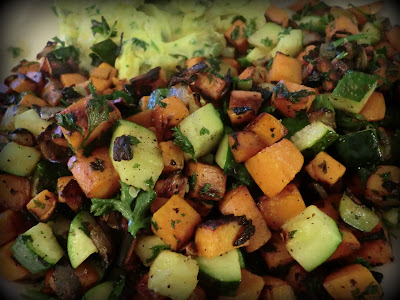
This morning's breakfast hash is a great example of how a trusty regular can be so easily improved by this small switch--they cut more easily, cook faster so don't soak up the same amount of oil, and develop deeper sweeter flavor. Every bite of sweet potato, onion, zucchini, and parsley was simple and pure heaven.
I've also grown up on sweet potatoes, baked in their skins and eaten simply with butter and salt. However, it wasn't until sweet potato fries became prevalent that I started thinking of that "other potato" as an alternative to (and tastier version of) the good ol' spud. I love a plate of sweet potato fries 'way beyond what I ever felt for regular white fries, but they still aren't all that healthy, with the extra starch coating given all fries to make them crisp up more easily. (By the way, boiled sweet potatoes supposedly have much lower glycemic load than baked, since the shorter cooking time reduces sugar conversion.)

This morning's breakfast hash is a great example of how a trusty regular can be so easily improved by this small switch--they cut more easily, cook faster so don't soak up the same amount of oil, and develop deeper sweeter flavor. Every bite of sweet potato, onion, zucchini, and parsley was simple and pure heaven.
Friday, January 18, 2013
Deep green, deep flavor
A blogger's obsession with kale inspired me to grab a bunch on my last trip to Stater Brothers. It's such a beautiful green but I have tended to think of it just as the frilly but indestructible filler wedged between bowls in a cafeteria salad bar.
It's Friday, and a late afternoon run delivered me home with a hungry tummy and less patience than I normally have for making the meal that starts out my weekend. I just wanted supper!
First thing, get some pasta boiling. Whole wheat, something that'll stick to my ribs.
Then, saute up some onion, garlic, and mushrooms--a base for the kale, just because eating kale after a five-mile run seems like what one ought to do. I'd forgotten how long kale takes to cook, so when it wasn't softening up fast enough, even though I'd sliced out the ribs and chopped it fairly small, I poured in a little pasta water and slapped a lid on the frying pan (cast iron, of course!).
Finishing touches included dried basil, a few pepper flakes, and my favorite chopped walnuts. When I sprinkled parmesan on the dish and dug in, I was just expecting a forkful of healthy, satisfying pasta. What surprised me was how complex and charming the flavor profile was. Layers of nutty--the expected flavor from the wheat pasta and the walnuts, enhanced by unexpected nuttiness from the kale. Now I understand that blogger's obsession with it, and am now on my own dark green odyssey.
It's Friday, and a late afternoon run delivered me home with a hungry tummy and less patience than I normally have for making the meal that starts out my weekend. I just wanted supper!
First thing, get some pasta boiling. Whole wheat, something that'll stick to my ribs.
Then, saute up some onion, garlic, and mushrooms--a base for the kale, just because eating kale after a five-mile run seems like what one ought to do. I'd forgotten how long kale takes to cook, so when it wasn't softening up fast enough, even though I'd sliced out the ribs and chopped it fairly small, I poured in a little pasta water and slapped a lid on the frying pan (cast iron, of course!).
Finishing touches included dried basil, a few pepper flakes, and my favorite chopped walnuts.

Thursday, July 5, 2012
Can't leave a good thing alone
As you know from earlier posts, I have the perfect pie crust recipe. Never-fail, turns out exactly the same every time. So how could I end up with anything less than perfect pie?
I blame the low-sugar, no-white flour, mostly vegan culinary journey I'm taking this summer, trying to get my body in the best shape I can for some upcoming distance running challenges (some of the greatest American distance athletes, such as ultramarathoner Scott Jurek and pro cycling stud David Zabriskie are vegan. Ergo my foray into falafel burgers). I haven't thought about white flour for quite a while, but it didn't occur to me that I wouldn't have any in stock when the 4th of July came around--a day that always calls for apple pie. I've got my butter and crisco chilling, water and vodka all icy, and no white flour. But I do have whole grain pastry flour--it being pastry flour should make up for not being refined, right?
Wrong. I ended up with a soggy, squishy mass of dough that would barely shape into crust. In the end it tasted quite good, but what a difficult mess! The fact that it was quite healthy (aside from all that lovely butter and crisco) was my only consolation. Moral of this story: when you're baking, don't mess around with ingredients. Head out the door, get that white flour, and do it right.
To make up for my uncertainty with the pie crust, I put extra effort into the filling. That's what's lovely about pie filling--it's more like cooking (which I love) than baking (which always challenges me) in that ingredients are flexible and can always be messed with.
I did take care with the size and shape of the apple pieces for optimal texture. Since I still didn't have white flour, I used soy flour as my thickener instead, and it worked beautifully--I think I'll stick with it for this purpose. To complement the whole grain crust, I increased the proportion of brown sugar, using very little white. I tossed in a few splashes of vanilla extract, and orange juice instead of lemon, relying on a little rice vinegar to provide an acidic kick. Zesting the orange peel pumped up the citrus aspects, and then to top it all off, along with the usual cinnamon, dash of salt and splashes of tabasco, on impulse I threw in fresh-cracked black pepper. Even though sampling the filling mixture didn't give me a clear idea of the final outcome, I trusted that baking would develop and draw these ingredients into harmony--which is exactly what happened. It was apple pie, yes, but apple on steroids. You might wonder what new or ancient variety, what heirloom apples from what special farmers' market nestled between those ugly (but tasty) brown crusts? Certainly not those one-note standbys, Granny Smiths. That's the magic of orange zest and rice vinegar and vanilla and especially (I believe) cracked black pepper.
From now on, not only will I always mince jalapeno into my strawberry jam, but never forget to include the cracked black pepper in my apple pie.
I blame the low-sugar, no-white flour, mostly vegan culinary journey I'm taking this summer, trying to get my body in the best shape I can for some upcoming distance running challenges (some of the greatest American distance athletes, such as ultramarathoner Scott Jurek and pro cycling stud David Zabriskie are vegan. Ergo my foray into falafel burgers). I haven't thought about white flour for quite a while, but it didn't occur to me that I wouldn't have any in stock when the 4th of July came around--a day that always calls for apple pie. I've got my butter and crisco chilling, water and vodka all icy, and no white flour. But I do have whole grain pastry flour--it being pastry flour should make up for not being refined, right?
Wrong. I ended up with a soggy, squishy mass of dough that would barely shape into crust. In the end it tasted quite good, but what a difficult mess! The fact that it was quite healthy (aside from all that lovely butter and crisco) was my only consolation. Moral of this story: when you're baking, don't mess around with ingredients. Head out the door, get that white flour, and do it right.
To make up for my uncertainty with the pie crust, I put extra effort into the filling. That's what's lovely about pie filling--it's more like cooking (which I love) than baking (which always challenges me) in that ingredients are flexible and can always be messed with.
I did take care with the size and shape of the apple pieces for optimal texture. Since I still didn't have white flour, I used soy flour as my thickener instead, and it worked beautifully--I think I'll stick with it for this purpose. To complement the whole grain crust, I increased the proportion of brown sugar, using very little white. I tossed in a few splashes of vanilla extract, and orange juice instead of lemon, relying on a little rice vinegar to provide an acidic kick. Zesting the orange peel pumped up the citrus aspects, and then to top it all off, along with the usual cinnamon, dash of salt and splashes of tabasco, on impulse I threw in fresh-cracked black pepper. Even though sampling the filling mixture didn't give me a clear idea of the final outcome, I trusted that baking would develop and draw these ingredients into harmony--which is exactly what happened. It was apple pie, yes, but apple on steroids. You might wonder what new or ancient variety, what heirloom apples from what special farmers' market nestled between those ugly (but tasty) brown crusts? Certainly not those one-note standbys, Granny Smiths. That's the magic of orange zest and rice vinegar and vanilla and especially (I believe) cracked black pepper.
From now on, not only will I always mince jalapeno into my strawberry jam, but never forget to include the cracked black pepper in my apple pie.
Tuesday, June 19, 2012
Falafel Burgers
On a recent stay in Santa Barbara, I discovered the joy of falafel burgers at a place called The Habit. With a basket of sweet potato fries on the side, I was in heaven. It was one of those meals that you savor as you eat, and then again in memory.
My brother Doug teaches cooking and healthy lifestyle classes with his wife Patricia. He's always looking for a better veggie burger recipe, and when I heard an NPR interview with a chef who'd devoted a whole cookbook to the topic, I immediately thought of Doug, hopped on Amazon, and ordered a copy for his birthday. I got myself a copy as well, but let it sit on the shelf until that happy meal at The Habit. Suddenly, I was all about digging into Lukas Volger's Veggie Burgers Every Which Way.
Sure enough, there was a falafel burger recipe. I've made it twice already in the past week, even though there are so many other enticing burgers that I ought to branch out. However, it's fun to really learn a recipe, go to school on it. The burgers were tasty the first time, but I wanted to improve my results. There are things I like better about my second try, but others that I preferred about my first. I'm definitely giving this recipe a few more rounds along with sampling other burgers from the book. It's not like the recipes are so complicated, but having my best version of something makes me happy.
What made the second try a little more complicated was my inattention at the start--I soaked double the amount of chickpeas, then decided to simply double the whole recipe rather than waste the rehydrated peas. My food processor isn't big enough to handle so much volume, and working in stages got in the way of attaining an ideal texture. However, the ingredients were better. This time, I had cumin seeds--last time I'd settled for ground cumin. The recipe calls for thickening (only if necessary) with a little chickpea flour; so far I haven't located any. The first go round I used whole wheat, this time it was soy flour, just to be different. Next I'll try it without the flour--the mixture seems so loose and wet when forming the patties, but baking dries it out quite a bit, and it should still hold together, not crumble, even without the help of an extra binding agent.
 I also tossed in a fat handful each of chia and flax seeds in honor of ultramarathoner (and vegan foodie) Scott Jurek, whose Eat & Run not only offers great nutrition advice but concludes each chapter with an enticing recipe.
Next time I'll be patient and grind the flax seeds first--their crunch was a little too assertive, and the body can't absorb as many nutrients from whole seeds. They aren't all all necessary to the recipe, but it's always good to find ways to incorporate flax into one's diet, particularly for runners (and women--especially peri- or post-menopausal).
Today I stacked the burger with some tzatziki-inspired cucumbers, fresh tomatoes, and lightly wilted purple kale. I thinly sliced the cucumbers and onions, sprinkled them with salt, pepper, dried mint, and lemon juice, and mashed them into plain Greek yogurt.
Even though handling so much falafel mixture was a pain, I'm not sorry to have 11 more burgers stashed in the freezer. My experience with the first batch is that the flavor develops even more over the next 24 hours, and the patties heat up beautifully in the microwave without affecting texture.
Lukas Volger shares many of his recipes on his website: www.lukasvolger.com, although this one isn't there. It's best to just buy his wonderful cookbook, but if you want to try the burger, another blogger did post the recipe, along with her tips: www.madriverkitchen.com/2011/04/baked-falafel-burger-with-tzatziki.html
I'll add to the post as I work on the recipe, but it's all about tweaking my rendition of it, not the recipe itself, which is simply wonderful and easy to produce (so long as you don't double the chickpeas and decide to go ahead and run with it).
My brother Doug teaches cooking and healthy lifestyle classes with his wife Patricia. He's always looking for a better veggie burger recipe, and when I heard an NPR interview with a chef who'd devoted a whole cookbook to the topic, I immediately thought of Doug, hopped on Amazon, and ordered a copy for his birthday. I got myself a copy as well, but let it sit on the shelf until that happy meal at The Habit. Suddenly, I was all about digging into Lukas Volger's Veggie Burgers Every Which Way.
Sure enough, there was a falafel burger recipe. I've made it twice already
 in the past week, even though there are so many other enticing burgers that I ought to branch out. However, it's fun to really learn a recipe, go to school on it. The burgers were tasty the first time, but I wanted to improve my results. There are things I like better about my second try, but others that I preferred about my first. I'm definitely giving this recipe a few more rounds along with sampling other burgers from the book. It's not like the recipes are so complicated, but having my best version of something makes me happy.
What made the second try a little more complicated was my inattention at the start--I soaked double the amount of chickpeas, then decided to simply double the whole recipe rather than waste the rehydrated peas. My food processor isn't big enough to handle so much volume, and working in stages got in the way of attaining an ideal texture. However, the ingredients were better. This time, I had cumin seeds--last time I'd settled for ground cumin. The recipe calls for thickening (only if necessary) with a little chickpea flour; so far I haven't located any. The first go round I used whole wheat, this time it was soy flour, just to be different. Next I'll try it without the flour--the mixture seems so loose and wet when forming the patties, but baking dries it out quite a bit, and it should still hold together, not crumble, even without the help of an extra binding agent.
 I also tossed in a fat handful each of chia and flax seeds in honor of ultramarathoner (and vegan foodie) Scott Jurek, whose Eat & Run not only offers great nutrition advice but concludes each chapter with an enticing recipe.
 Next time I'll be patient and grind the flax seeds first--their crunch was a little too assertive, and the body can't absorb as many nutrients from whole seeds. They aren't all all necessary to the recipe, but it's always good to find ways to incorporate flax into one's diet, particularly for runners (and women--especially peri- or post-menopausal).
Today I stacked the burger with some tzatziki-inspired cucumbers, fresh tomatoes, and lightly wilted purple kale.
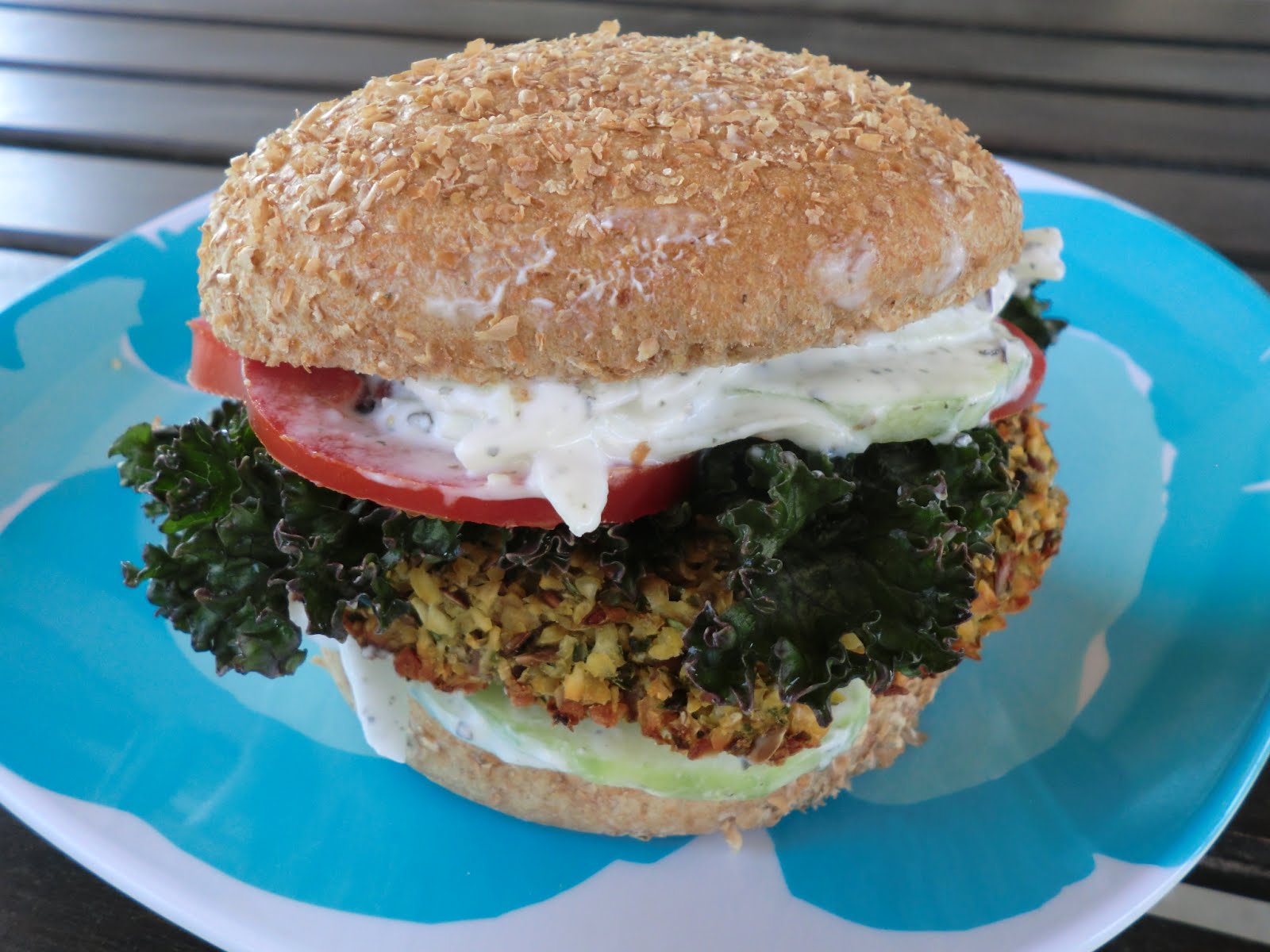 I thinly sliced the cucumbers and onions, sprinkled them with salt, pepper, dried mint, and lemon juice, and mashed them into plain Greek yogurt.
 Even though handling so much falafel mixture was a pain, I'm not sorry to have 11 more burgers stashed in the freezer. My experience with the first batch is that the flavor develops even more over the next 24 hours, and the patties heat up beautifully in the microwave without affecting texture.
Lukas Volger shares many of his recipes on his website: www.lukasvolger.com, although this one isn't there. It's best to just buy his wonderful cookbook, but if you want to try the burger, another blogger did post the recipe, along with her tips: www.madriverkitchen.com/2011/04/baked-falafel-burger-with-tzatziki.html
I'll add to the post as I work on the recipe, but it's all about tweaking my rendition of it, not the recipe itself, which is simply wonderful and easy to produce (so long as you don't double the chickpeas and decide to go ahead and run with it).
Subscribe to:
Posts (Atom)